
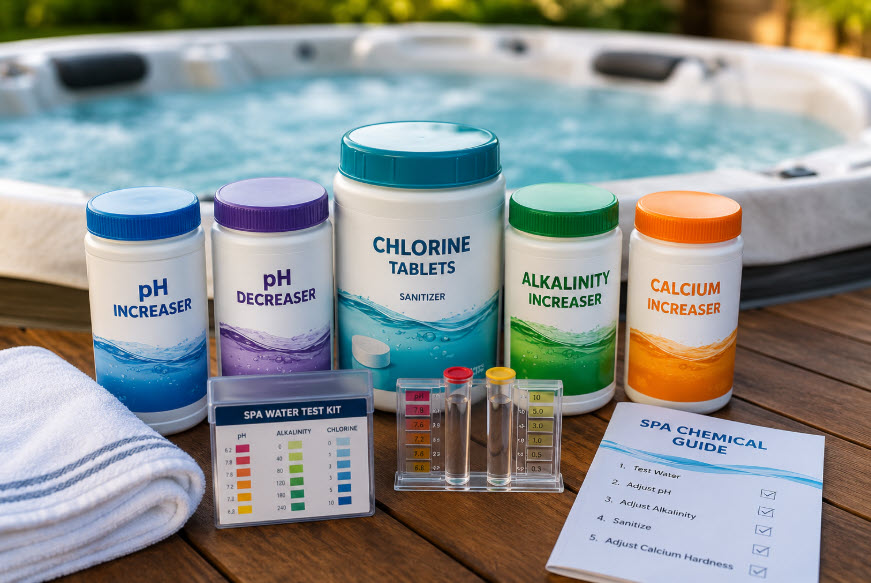
Maintaining the right hot tub chemical balance is one of the most important parts of keeping your spa water clean, clear, comfortable, and ready to enjoy. For beginners, learning how to balance hot tub water means focusing on three key areas: total alkalinity, pH, and sanitizer levels—and testing them regularly.
The good news? Hot tub water chemistry doesn’t have to be complicated. Once you understand what each chemical level does and follow the correct order when balancing your water, routine spa maintenance can become a quick part of your weekly schedule.
At Avalon Pools & Spas in Milton, Vermont, our team helps hot tub owners understand their water, choose the right spa chemicals, and troubleshoot problems before cloudy, foamy, discolored, or irritating water gets in the way of enjoying their hot tub.
Here’s what every hot tub owner should know.
What Is the Proper Chemical Balance for a Hot Tub?
For most hot tubs, owners should monitor total alkalinity, pH, sanitizer, and calcium hardness. Always follow the ranges specified by your spa manufacturer and chemical system, but commonly recommended targets include:
| Water Measurement | Common Target Range |
|---|---|
| Total Alkalinity | 80–120 ppm |
| pH | 7.2–7.8 |
| Free Chlorine | At least 3 ppm |
| Bromine | 4–8 ppm |
| Calcium Hardness | Follow manufacturer guidance |
The CDC recommends maintaining hot tub water at a pH of 7.0–7.8 and a chlorine concentration of at least 3 ppm; for spas using bromine, it recommends 4–8 ppm.
Your particular hot tub or chemical system may call for a narrower ideal range, so always follow its instructions.
Why does hot tub water need to be balanced?
Balanced water isn’t just about making your spa look good.
Proper hot tub water chemistry helps sanitizer work effectively, makes the water more comfortable for bathers, and helps protect spa components from problems associated with corrosive or scale-forming water.
Think of your spa water as a system: when one measurement gets too far out of range, it can affect the others.
Balance Hot Tub Chemicals in the Right Order
One of the most common beginner mistakes is trying to correct everything at once.
Instead, test your water and make adjustments systematically.
A good general sequence is:
1. Total alkalinity → 2. pH → 3. Sanitizer
Why alkalinity first?
Total alkalinity helps buffer your water against sudden changes in pH. If alkalinity is significantly out of range, you may find yourself repeatedly adjusting pH only for it to move again.
Once alkalinity is where it needs to be, check your pH. Then make sure your chlorine, bromine, or other approved sanitizer system is maintained according to its instructions.
Avoid randomly adding multiple chemicals at the same time. Follow product directions for dosing, circulation, testing, and how long to wait between adjustments.
Understanding Hot Tub Alkalinity
Total alkalinity measures your water’s ability to resist changes in pH.
When alkalinity is too low, pH can become unstable and change rapidly. When it’s too high, adjusting pH can become difficult and water may become more prone to cloudiness or scale.
A commonly used target is 80–120 ppm, although you should use the range recommended for your specific spa and chemical system.
Signs your alkalinity may need attention
You might notice:
- pH that changes frequently
- Difficulty maintaining your desired pH
- Cloudy water
- Scale or deposits
- Water that becomes difficult to balance
If you feel like you’re constantly chasing your hot tub’s pH level, checking total alkalinity is a smart first step.
What Should the pH Level Be in a Hot Tub?
Your hot tub’s pH measures how acidic or basic the water is.
The CDC recommends a pH between 7.0 and 7.8 for hot tubs. Many spa-care systems target a somewhat narrower range within those parameters, so check your manufacturer’s recommendations.
What happens when hot tub pH is too low?
Low pH means the water is more acidic. It can contribute to:
- Eye or skin irritation
- Corrosion of spa equipment and surfaces
- Faster sanitizer depletion
What happens when hot tub pH is too high?
High pH can contribute to:
- Cloudy water
- Scale formation
- Reduced effectiveness of chlorine-based sanitation
- Deposits on spa surfaces or components
This is why simply adding more sanitizer isn’t necessarily the solution when your water doesn’t look right. The underlying water balance may be the problem.
Chlorine vs. Bromine: Understanding Hot Tub Sanitizer
Sanitizer helps control bacteria and other microorganisms in spa water.
Two commonly used hot tub sanitizers are chlorine and bromine.
According to the CDC, hot tubs should maintain at least 3 ppm chlorine or 4–8 ppm bromine.
Whichever system your spa uses, consistency matters.
Hot tubs have relatively small volumes of warm water and can experience substantial changes in water chemistry after people use them. Sweat, body oils, cosmetics and other contaminants all add to the sanitizer’s workload.
That’s one reason regular hot tub water testing is so important.
How Often Should You Test Hot Tub Water?
For residential hot tubs, a practical routine is to test the water several times per week and before use, with additional testing after heavy use or whenever the water looks, smells, or feels different.
You should also test after adding fresh water or making significant chemical adjustments.
Test strips are convenient for routine checks. A more detailed water analysis can be helpful when you’re struggling with a recurring problem or can’t figure out why your numbers won’t stay balanced.
That’s where having a local hot tub and spa store in Vermont can be especially useful.
Avalon Pools & Spas in Milton provides professional water testing and can help customers understand what their results mean instead of simply guessing which chemical to add next.
Hot Tub Water Troubleshooting: What Is Your Water Telling You?
Why is my hot tub water cloudy?
Cloudy hot tub water can have several causes, including inadequate sanitizer, improper water balance, dirty filters, high bather load, or dissolved contaminants.
Start by testing the water rather than automatically adding chemicals.
Check:
Sanitizer → pH → alkalinity → filter condition
Also consider when the water was last changed and whether the spa has recently had unusually heavy use.
Why is my hot tub water foamy?
Foam can result from substances introduced into the water, including lotions, cosmetics, detergents remaining in bathing suits, body oils, or other organic material.
Water balance and filtration can also play a role.
If foam keeps returning, don’t just continually add a defoaming product. Identify what’s causing it.
Why does my hot tub smell strongly like chlorine?
A strong “chlorine smell” does not necessarily mean there’s too much effective chlorine.
Chloramines can form when chlorine reacts with contaminants introduced by bathers. Testing your water provides much more useful information than relying on smell alone.
Why does my hot tub water look green?
Green or discolored spa water can have multiple causes, including water chemistry issues, contaminants, or metals in the source water.
Test before treating. If you’re unsure what you’re seeing, bring a water sample to a spa professional rather than repeatedly adding products and hoping one solves it.
Why does my skin feel irritated after using my hot tub?
Improper pH, sanitizer levels, or other water-quality issues may contribute to skin and eye irritation.
If the water doesn’t test within the appropriate ranges, don’t use the spa until the issue has been corrected. If irritation persists despite properly maintained water, discontinue use and consider other potential causes.
Your Easy Hot Tub Maintenance Schedule
You don’t need to spend hours every week maintaining your spa. Consistency is much more important.
Before Use / Several Times Per Week
- Test sanitizer and pH
- Check water clarity
- Check the water level
- Adjust chemicals according to product directions
Weekly
- Test alkalinity
- Inspect the filter
- Check for unusual foam, odors or discoloration
- Clean the waterline as needed
- Review sanitizer levels after heavier-than-normal use
Monthly
Use this monthly hot tub maintenance checklist:
- Perform a complete water chemistry test
- Confirm pH and alkalinity are stable
- Check sanitizer levels
- Check calcium hardness as appropriate
- Thoroughly clean the filter according to manufacturer instructions
- Inspect the cover
- Inspect jets and visible spa surfaces
- Check for scale or mineral buildup
- Review your supply of spa chemicals
- Get professional water testing if you’re having recurring issues
Your spa manufacturer may recommend additional maintenance, so your owner’s manual should always take precedence.
Do You Need to Drain and Refill a Hot Tub?
Eventually, adjusting chemicals isn’t enough.
Over time, dissolved substances accumulate in spa water. Your hot tub manufacturer should provide guidance on how frequently the spa should be drained and refilled based on usage and water-care system.
When it’s time for a deeper reset, Avalon offers a hot tub drain, clean and refill service in Milton. The service includes draining the spa, cleaning surfaces and jets, cleaning or replacing filters as needed, refilling the spa, and balancing the water chemistry.
That’s particularly helpful for owners who want professional seasonal maintenance or have inherited water that has become difficult to manage.
Vermont Hot Tub Maintenance Requires Year-Round Attention
For hot tub owners in Milton, Burlington, Colchester, Essex, St. Albans, and throughout Northwestern Vermont, water care doesn’t stop when temperatures fall.
In fact, winter is when many Vermonters get the most enjoyment out of their spas.
Keeping the water level, chemistry, filtration, heating system, and cover in good condition becomes especially important during freezing weather. Avalon recommends regularly checking water chemistry and equipment during winter and addressing unusual heating behavior, error codes, noises, low water pressure, or ice around equipment promptly.
If you’re maintaining a hot tub in Vermont, having a local source for water testing, chemicals, maintenance, and repairs can be considerably more convenient than troubleshooting everything on your own.
Hot Tub Chemicals & Professional Water Testing in Milton, VT
You can absolutely learn to maintain your own hot tub water.
But you don’t have to become a chemist to own a spa.
Avalon Pools & Spas in Milton, Vermont provides spa owners with professional water testing, quality hot tub chemicals, maintenance services, and experienced guidance for keeping their water clean and properly balanced.
If your spa water is cloudy, foamy, discolored, difficult to balance—or you simply aren’t sure what your test results mean—bring a water sample to Avalon rather than guessing.
The goal isn’t to add more chemicals.
It’s to add the right amount of the right product based on what your water actually needs.
Frequently Asked Questions About Hot Tub Water Chemistry
What chemicals do I need for a hot tub?
Most hot tub water-care programs require products to manage sanitizer, pH, and alkalinity, with additional products potentially needed for calcium hardness, oxidation/shocking, or specific water conditions. The exact products depend on your spa and sanitation system.
What should I balance first in my hot tub?
Start with total alkalinity, then adjust pH, followed by sanitizer. Stabilizing alkalinity first can make it easier to maintain a consistent pH.
What pH should a hot tub be?
The CDC recommends maintaining hot tub water between pH 7.0 and 7.8. Your spa or chemical manufacturer may recommend a narrower ideal range within those parameters.
How much chlorine should be in a hot tub?
The CDC recommends maintaining at least 3 ppm chlorine in hot tubs. Follow the instructions for your particular sanitation system and test regularly.
What is the correct bromine level for a hot tub?
The CDC recommends 4–8 ppm bromine for hot tubs using bromine as their sanitizer.
Why can’t I get my hot tub chemicals balanced?
Persistent water-balance problems can result from several factors, including alkalinity, source-water chemistry, heavy spa use, contaminants, filtration issues, or older water. A complete professional water test can help identify the underlying problem instead of repeatedly treating individual symptoms.
Where can I get my hot tub water tested near Burlington, VT?
Avalon Pools & Spas in Milton, Vermont offers professional pool and spa water testing and can recommend appropriate products based on the results. The company also provides spa maintenance and repair services for local hot tub owners.
Clear Water Starts With Consistent Hot Tub Care
The secret to hot tub chemical balance isn’t constantly adding chemicals—it’s testing consistently and making targeted adjustments.
Remember the basics:
Test regularly. Balance alkalinity first. Adjust pH. Maintain the proper sanitizer level. Keep your filter clean. And address water problems before they become bigger ones.
Once those habits become routine, maintaining clean, inviting spa water gets much easier.
For Vermont hot tub owners who would rather have an expert double-check their water, visit Avalon Pools & Spas in Milton, VT for professional water testing, spa chemicals, maintenance products, and local guidance to help keep your hot tub crystal clear year-round.