
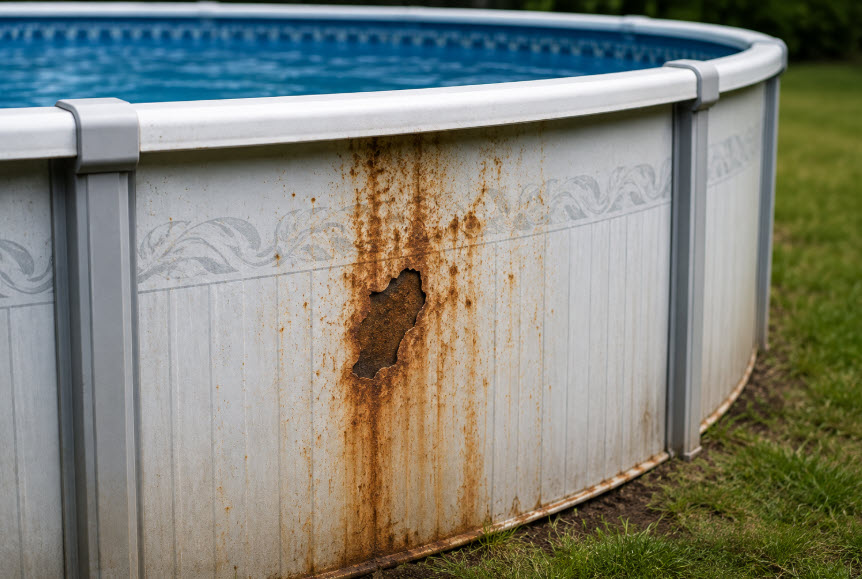
Above ground pool rust wall repair may be possible when corrosion is caught early, but significant rust can weaken the pool wall and become a serious structural concern. Small areas of surface rust may sometimes be cleaned, treated, and protected, while deep corrosion, holes, rust around critical structural areas, or widespread deterioration may require professional repair or even wall or pool replacement.
That’s an important distinction because the steel wall of an above ground pool isn’t simply cosmetic—it helps contain thousands of gallons of water under significant pressure.
For homeowners in Milton, Burlington, Colchester, Essex, St. Albans, and throughout Northwestern Vermont, moisture, snow, freeze-thaw cycles, drainage issues, and years of outdoor exposure can all contribute to corrosion.
If you’ve discovered a rusted above ground pool wall, don’t panic—but don’t ignore it either. Here’s how to determine what you’re dealing with and what to do next.
Is Rust on an Above Ground Pool Wall Dangerous?
It can be.
The seriousness of above ground pool wall rust depends on its location, depth, and how much of the metal has deteriorated.
A small patch of superficial oxidation on otherwise solid metal is very different from corrosion that has eaten through the wall.
Surface rust
Surface rust typically affects the exterior coating and uppermost layer of metal. The wall underneath may still feel solid and structurally sound.
When caught early, this is the type of rust most likely to be treatable.
Deep or structural rust
Rust becomes much more concerning when the metal is:
- Flaking heavily
- Pitted or thinning
- Soft or weak
- Bulging or distorted
- Rusted through
- Developing pinholes or larger holes
- Corroded extensively around the bottom of the wall
At this point, painting over the rust doesn’t restore the strength of the missing metal.
If you’re unsure whether the wall is structurally sound, stop treating the problem as a cosmetic repair and have the pool inspected by a professional.
Why Do Above Ground Pool Walls Rust?
Steel above ground pool walls are manufactured to withstand outdoor exposure, but damage to their protective coating can expose the underlying metal to moisture and oxygen.
Several conditions can accelerate that process.
Water Around the Bottom of the Pool
Poor drainage can allow water to continually sit around the pool’s base.
Rainwater, runoff, snowmelt, or improper grading can create a consistently damp environment around the bottom track and wall.
Over time, that can encourage corrosion.
Vermont’s climate makes drainage especially important because pools are exposed to rain, snow accumulation, spring snowmelt, and repeated freeze-thaw cycles.
Damage to the Pool Wall’s Protective Finish
Scratches, chips, dents, or other damage can compromise the coating that protects steel from corrosion.
Even a relatively small exposed area can become a starting point for rust.
Pool Water Leaks
A liner leak can introduce moisture where it doesn’t belong.
If you notice rust accompanied by unexplained water loss, don’t assume they’re unrelated. Identifying and correcting the source of the moisture is just as important as treating the corrosion.
Chlorinated Water and Pool Chemicals
Pool chemicals need to be handled carefully.
Concentrated chemicals or chlorinated water repeatedly contacting metal surfaces can contribute to corrosion, particularly if the protective finish has already been compromised.
Store and use pool chemicals according to manufacturer directions and avoid allowing concentrated products to sit against the pool wall or frame.
Age and Normal Exposure
Even a well-maintained above ground pool experiences years of sun, rain, humidity, snow, and temperature changes.
As the pool ages, regularly inspecting metal components becomes increasingly important.
Where Should You Check an Above Ground Pool for Rust?
If you’ve found one rust spot, inspect the entire pool rather than assuming it’s isolated.
Pay special attention to:
The bottom edge of the pool wall.
This area can be exposed to persistent moisture from the ground, grass, landscaping, snow, and runoff.
Around the skimmer and return opening.
These are penetrations through the wall and deserve regular inspection for corrosion or water leakage.
Wall seams.
Look for bubbling paint, staining, flaking, or corrosion.
Behind uprights and structural components.
Some deterioration can be partially hidden.
The bottom track.
Check visible areas for deterioration and drainage problems.
Any scratched or damaged areas.
A break in the protective finish gives corrosion an opportunity to begin.
Make this inspection part of your normal above ground pool maintenance, particularly during spring opening and fall closing.
Can You Repair a Rusted Above Ground Pool Wall?
Sometimes—but the right repair depends entirely on the severity of the corrosion.
Minor Surface Rust
If the rust is truly superficial and the underlying steel remains solid, the affected area may be treatable.
A typical surface rust repair may involve:
- Identifying and correcting the source of moisture.
- Cleaning the affected area.
- Removing loose rust and deteriorated coating.
- Preparing the remaining solid metal.
- Applying an appropriate rust-inhibiting treatment or primer.
- Protecting the repaired area with a coating suitable for the application.
Always follow the pool manufacturer’s guidance and the instructions for any repair products.
Most importantly, don’t assume rust is superficial just because the visible spot is small.
Corrosion can extend farther beneath a coating than what is visible from the outside.
What If the Pool Wall Has a Rust Hole?
A rust hole changes the conversation.
The pool wall is a structural component. Once corrosion has penetrated the steel, simply sanding, filling, or painting the area does not replace the metal strength that has been lost.
You may find DIY instructions online involving sheet metal patches and other modifications. Be extremely careful with this advice.
A repair that conceals a hole isn’t necessarily a structurally appropriate pool wall repair.
The consequences of a wall failure on a filled above ground pool can be significant because the pool contains an enormous amount of water.
If the wall has rusted through, have the damage professionally evaluated before continuing to use or refill the pool.
Rust Around the Skimmer Requires Extra Attention
The skimmer opening is one area where above ground pool owners commonly notice corrosion.
That’s partly because the skimmer requires an opening through the steel wall and is an area where water may be present.
Small signs of corrosion shouldn’t automatically mean the entire pool needs replacement, but the area should be evaluated carefully.
Check for:
- Rust spreading outward from the opening
- Water leakage
- Loose skimmer components
- Significant pitting
- Thinning metal
- Cracks or deformation
- Holes extending beyond the skimmer opening
A deteriorating structural area shouldn’t simply be hidden behind a new skimmer faceplate.
Rust Along the Bottom of an Above Ground Pool Wall
Rust near the bottom edge deserves particular attention.
The lower wall helps transfer loads into the track and pool structure, and this area can also be susceptible to persistent ground moisture.
If you find extensive rust around the bottom perimeter, inspect the surrounding conditions.
Is water pooling against the pool?
Is landscaping holding moisture against the wall?
Does snowmelt drain toward the pool?
Is vegetation growing directly against it?
Is the bottom track also deteriorating?
Treating the visible rust without addressing the underlying drainage issue can allow the problem to return.
When Should a Rusted Above Ground Pool Be Replaced?
There isn’t one universal amount of rust that determines whether every pool can be saved.
However, replacement becomes a much more serious consideration when there is:
- Widespread wall corrosion
- Significant metal loss
- Multiple rust holes
- Extensive bottom-edge corrosion
- Structural deformation or bulging
- Severely deteriorated tracks or frame components
- Damage that cannot be repaired according to manufacturer guidance
- Multiple major problems on an older pool
At some point, investing heavily in a deteriorated structure doesn’t make financial or safety sense.
A professional above ground pool inspection can help determine whether you’re dealing with a maintenance issue, repairable damage, or a pool approaching the end of its useful life.
Can You Replace Just the Wall of an Above Ground Pool?
Potentially, but it depends heavily on the pool.
Replacement walls may not be available for every manufacturer, model, or age of pool. Compatibility with the existing frame, liner, tracks, skimmer openings, and other components also matters.
Labor is another consideration.
Replacing an above ground pool wall isn’t like replacing a decorative exterior panel. The pool generally needs to be drained and partially disassembled, and other aging components may be exposed during the process.
If several major components need replacement, purchasing a new pool may make more sense.
This is where comparing repair cost vs. replacement cost becomes important.
How to Prevent Rust on an Above Ground Pool
The best rust repair is the one you never need.
Keep Water Away From the Pool Base
Make sure the surrounding area drains properly and doesn’t allow water to continually collect against the wall or track.
Inspect the Wall Regularly
Look for:
- Scratches
- Bubbling coatings
- Orange or brown discoloration
- Flaking
- Pitting
- Leaks
- Damp areas around the base
Catching corrosion when it’s the size of a quarter is much better than discovering it after it has spread several feet.
Address Leaks Promptly
Don’t allow a small liner, skimmer, return, or plumbing leak to continually expose metal components to water.
Protect the Exterior Coating
If the manufacturer’s instructions allow it, properly address chips or scratches before corrosion has an opportunity to spread.
Maintain Proper Pool Chemistry
Balanced water protects more than swimmers.
Consistently improper water chemistry can contribute to problems with pool surfaces and equipment.
Professional water testing can help you understand exactly what your pool needs instead of repeatedly adding chemicals based on guesswork.
Winterize Properly
For Vermont pool owners, a good closing is part of long-term pool protection.
Properly winterizing your pool and periodically inspecting it throughout winter can help identify cover, drainage, snow, ice, or equipment issues before spring.
Should You Repair Above Ground Pool Rust Yourself?
Minor cosmetic surface rust may be manageable for an experienced DIY homeowner, provided the metal underneath is unquestionably sound and the repair follows the pool manufacturer’s recommendations.
The key word is minor.
Professional evaluation is the better choice when:
- Rust has created a hole
- The metal feels thin or weak
- The wall is bulging
- Corrosion is widespread
- Rust is extensive around the bottom edge
- Structural components are deteriorating
- The pool is leaking
- You’re unsure how deep the corrosion goes
When thousands of gallons of water are being held back by the wall you’re evaluating, this isn’t a great place for guesswork.
Above Ground Pool Repair in Milton, VT
If you’re dealing with a rusted above ground pool wall in Vermont, Avalon Pools & Spas can help you determine the best next step.
Avalon Pools & Spas is a family-owned pool and spa company located at 332 US-7 in Milton, Vermont, with an experienced team providing pool maintenance, repairs, installations, water testing, seasonal services, and pool supplies.
For homeowners in Milton, Burlington, Colchester, Essex, St. Albans, and surrounding Northwestern Vermont communities, having the damage evaluated locally can help answer the most important question:
Is this pool worth repairing, or is replacement the safer and smarter investment?
Avalon can also help identify related issues—from liners and equipment to drainage, water care, and general pool condition—rather than simply treating the visible rust spot.
Frequently Asked Questions About Above Ground Pool Wall Rust
Can you repair rust on an above ground pool wall?
Minor surface rust may be repairable if the underlying steel remains structurally sound. Deep corrosion, significant metal loss, holes, bulging, or widespread deterioration should be professionally evaluated.
Is it safe to swim in a pool with a rusted wall?
A small superficial rust spot doesn’t necessarily mean the pool is unsafe, but you shouldn’t assume the corrosion is cosmetic without determining its severity. If the wall is weakened, perforated, bulging, or significantly deteriorated, stop using the pool and have it evaluated.
Can you patch a rust hole in an above ground pool wall?
A structural pool wall shouldn’t be treated like a simple cosmetic patch. Once rust has penetrated the steel, the extent and location of the damage need to be evaluated to determine whether an appropriate repair is possible.
Why is my above ground pool rusting at the bottom?
Persistent moisture is one possible cause. Poor drainage, snowmelt, vegetation, landscaping, leaks, and damage to the wall’s protective coating can contribute to corrosion around the lower wall and track.
Why is my pool wall rusting around the skimmer?
The skimmer requires an opening through the pool wall, and leaks or prolonged moisture around that area can contribute to corrosion. Inspect the gasket, skimmer assembly, surrounding steel, and liner for signs of leakage or deterioration.
How do I stop an above ground pool from rusting?
Maintain good drainage, address leaks quickly, protect the wall’s exterior coating, keep vegetation and persistent moisture away from the base, maintain appropriate water chemistry, and inspect the pool regularly for early signs of corrosion.
Can an above ground pool wall be replaced?
Replacement may be possible depending on the manufacturer, model, availability of compatible parts, and condition of the rest of the pool. For an older pool with several deteriorating components, full replacement may be more practical.
Where can I get above ground pool repair near Burlington, VT?
Avalon Pools & Spas in Milton, VT provides pool maintenance, repair, installation, and seasonal services for homeowners in the greater Burlington and Northwestern Vermont area.
Don’t Ignore Rust on Your Above Ground Pool
The most important thing to remember about above ground pool rust wall repair is that early corrosion and structural deterioration are two very different problems.
A small surface spot caught early may simply need proper preparation and protection.
A wall that has become thin, perforated, extensively corroded, or structurally compromised needs a different conversation.
Inspect it early. Find the source of the moisture. Determine how deep the damage goes. And don’t rely on a cosmetic patch when the steel itself has lost strength.
If you’re unsure what you’re looking at, contact Avalon Pools & Spas in Milton, VT for help evaluating your above ground pool and determining whether repair or replacement makes the most sense.