
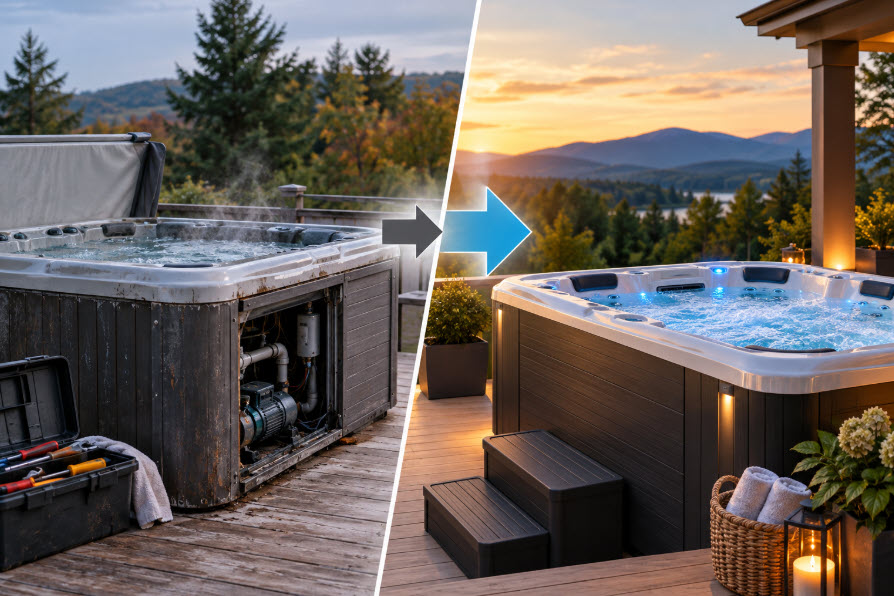
If your hot tub is leaking, struggling to heat, making strange noises, or requiring one repair after another, you may be wondering whether another service call is worth it. Hot tub repair vs. replacement usually comes down to five factors: the age of the spa, the type of problem, the cost of the repair, its overall condition, and how often it has needed service.
The short answer: Repair is usually worthwhile when your hot tub is relatively young, structurally sound, and experiencing one isolated problem such as a failed heater or pump. Replacement becomes more attractive when the spa is roughly 10–15+ years old, repairs are becoming frequent, energy costs are climbing, parts are difficult to find, or the shell, plumbing, insulation, and multiple major components are deteriorating.
For Vermont homeowners, there is another factor to consider: winter. A hot tub that cannot reliably maintain temperature during a Milton or Burlington-area winter can quickly go from inconvenient to potentially costly.
At Avalon Pools & Spas in Milton, VT, we help hot tub owners diagnose problems, repair serviceable equipment, and determine when putting more money into an aging spa no longer makes sense.
Hot Tub Repair vs. Replacement: A Quick Decision Guide
Here is a simple way to start:
| Your Hot Tub’s Condition | Repair or Replace? |
|---|---|
| Under 10 years old with one repairable issue | Usually repair |
| Heater isn’t working | Usually repair |
| Pump needs replacement | Usually repair |
| Minor plumbing leak | Often repair |
| Control system has one isolated failure | Often repair |
| 10–15+ years old with repeated problems | Consider replacement |
| Multiple expensive components are failing | Consider replacement |
| Significant structural shell damage | Replacement may make more sense |
| Parts are obsolete or difficult to source | Consider replacement |
| Energy costs have increased significantly | Compare replacement options |
| Spa regularly breaks down during winter | Strongly consider replacement |
There isn’t one magic age when every hot tub needs to be replaced. A well-maintained, quality spa can remain useful for many years, while a poorly maintained spa may become expensive to own much sooner.
The better question is: What will this hot tub cost me to keep operating over the next several years compared with replacing it now?
How Long Does a Hot Tub Last?
Many quality hot tubs can last 10 to 20 years or longer, depending on construction quality, maintenance, water chemistry, climate, usage, and whether repairs have been handled promptly.
The individual components don’t necessarily last as long as the spa itself. Pumps, heaters, seals, control systems, covers, and other components are designed to be serviced or replaced during a spa’s lifetime.
That distinction matters.
A 7-year-old hot tub with a bad heater doesn’t necessarily need to be replaced. The heater may simply be a worn component in an otherwise healthy spa.
On the other hand, a 15-year-old spa with a failing heater, deteriorating cabinet, recurring plumbing leaks, and an unreliable pump presents a very different equation.
Age alone shouldn’t decide whether you replace your hot tub.
Instead, evaluate:
- Age
- Repair history
- Current repair cost
- Structural condition
- Energy efficiency
- Parts availability
- Expected future repairs
Think of the spa as a complete system rather than focusing only on the component that happened to fail today.
7 Signs It May Be Time to Replace Your Hot Tub
1. Your Hot Tub Is 10–15+ Years Old and Repairs Are Becoming Frequent
An older spa isn’t automatically a bad spa.
The bigger warning sign is age combined with repeated repairs.
If you’ve recently replaced a pump and are now facing heater problems, leaks, control-board issues, or other failures, you should consider the cumulative cost rather than evaluating each repair individually.
Spending several hundred dollars on one repair may make perfect sense.
Spending money every few months to keep an aging spa running may not.
Ask yourself:
“If I make this repair, how confident am I that the spa will operate reliably for another few years?”
If the answer is “not very,” it may be time to compare new hot tubs.
2. You’re Dealing With Multiple Major Repairs at Once
A single failed component is often repairable.
Multiple failing systems are more concerning.
For example, imagine your spa needs a new pump but the technician also discovers aging plumbing, a deteriorating control system, and insulation problems.
Each individual issue may technically be repairable. The question is whether repairing all of them is financially sensible.
As repair costs begin approaching a meaningful percentage of the value of a replacement spa, ask for an honest repair-versus-replacement assessment before authorizing extensive work.
3. Your Hot Tub Has Major or Recurring Leaks
Not every hot tub leak means replacement.
Leaks can come from:
- Pump seals
- Unions and fittings
- Valves
- Plumbing connections
- Cracked pipes
- Jets
- Other serviceable components
Many of these can be repaired.
The situation changes when leaks are recurring, difficult to access, spread throughout aging plumbing, or associated with structural damage.
This is particularly important in Vermont, where a significant leak or equipment failure during freezing weather can create additional problems.
If your spa loses water repeatedly even after previous repairs, a professional inspection can help determine whether another repair is worthwhile.
4. The Hot Tub Shell Has Significant Structural Damage
The shell is one of the most important factors in the repair-versus-replace decision.
Pumps and heaters are components. They can be replaced.
Major structural deterioration is different.
Small cosmetic imperfections don’t necessarily mean a spa is finished, but substantial cracks, delamination, warping, or other structural problems may make replacement more practical.
This is one reason a professional diagnosis matters. Something that looks catastrophic to a homeowner may be repairable — and something that looks minor could indicate a larger underlying issue.
5. Replacement Parts Are Becoming Difficult to Find
Hot tub technology changes.
Manufacturers update:
- Control boards
- Pumps
- Heaters
- Topside controls
- Sensors
- Plumbing configurations
Eventually, parts for certain older models can become difficult or expensive to source.
If your technician has to hunt for obsolete components or repeatedly retrofit replacement equipment, that’s worth factoring into your decision.
You don’t want to spend heavily repairing a spa today only to discover that the next failed component is no longer available.
6. Your Hot Tub Is Becoming Expensive to Operate
Repair costs aren’t the only costs that matter.
Operating costs count too.
Older hot tubs may have deteriorating insulation, inefficient equipment, worn covers, or other problems that cause the system to work harder to maintain water temperature.
That’s especially relevant for hot tub owners in Milton, Burlington, Colchester, Essex, St. Albans, and other parts of northern Vermont, where maintaining spa temperature through cold winter conditions can put additional demands on the system.
If your spa seems to run constantly or you’re noticing unexplained increases in electricity usage, don’t automatically assume you need a new spa. Have the system evaluated first.
Sometimes the culprit is a serviceable problem, such as a damaged cover or equipment issue.
But if declining efficiency is one of several problems with an aging spa, replacement becomes much easier to justify.
7. You No Longer Trust Your Hot Tub to Work
This factor gets overlooked.
A hot tub is supposed to be something you enjoy — not something you’re constantly worried about.
If you’re wondering whether it will heat tonight, whether another leak is developing, or whether the breaker will trip again, reliability itself has value.
That becomes even more important in Vermont winters.
Eventually, the convenience and peace of mind that come with newer equipment may outweigh the benefit of squeezing another year or two out of an aging spa.
When Does Hot Tub Repair Still Make Sense?
There are plenty of situations where hot tub repair is absolutely the better option.
At Avalon Pools & Spas, our technicians repair spa pumps, heaters, plumbing leaks, and other spa-related problems. Before assuming you need an entirely new hot tub, it’s worth determining exactly what’s wrong.
Repair will often make sense when:
- The spa is still relatively young
- The shell and cabinet are in good condition
- You’ve had few previous problems
- The issue is limited to one component
- Replacement parts are readily available
- The repair cost is reasonable compared with the spa’s value
- The hot tub is otherwise efficient and reliable
A broken heater, pump, sensor, or other serviceable component does not automatically mean your hot tub has reached the end of its life.
How Much Should You Spend Repairing an Old Hot Tub?
There is no universal dollar amount because hot tubs vary dramatically in original price, quality, age, condition, and replacement cost.
A useful rule of thumb is to look carefully at replacement when a repair approaches 40–50% of the spa’s current value, particularly if the spa is older or has a history of other problems.
But don’t look at the current repair in isolation.
For example, a $700 repair on an otherwise excellent spa may be an easy decision.
A $700 repair after spending $1,500 on other problems over the previous year deserves more scrutiny.
Consider the total cost of ownership going forward:
Current repair + likely future repairs + energy costs + maintenance + expected remaining life
Then compare that with:
Cost of a new spa + warranty + improved efficiency + expected lifespan + reliability
That gives you a much more useful comparison than simply asking whether today’s repair is cheaper than buying a new hot tub.
Why Vermont’s Climate Matters
Hot tub ownership in Vermont is a little different from owning a spa somewhere with mild winters.
When temperatures fall below freezing, reliable circulation and heating become especially important.
A heating, pump, electrical, or circulation problem isn’t something you’ll necessarily want to ignore until spring. Extended equipment failure in freezing temperatures can put plumbing and other components at risk.
That’s why Avalon recommends having unusual behavior diagnosed early — particularly if your hot tub:
- Isn’t reaching its set temperature
- Takes much longer than usual to heat
- Frequently displays error codes
- Trips the breaker
- Loses water
- Has weak or inconsistent circulation
- Makes unusual pump noises
- Shuts down unexpectedly
Catching one failing component early can sometimes prevent a much more expensive problem later.
Repairing Your Current Spa vs. Upgrading to a New Hot Tub
Sometimes replacement isn’t just about fixing what’s broken.
Your needs may have changed since you originally purchased your spa.
Today’s hot tubs may offer improvements in areas such as energy efficiency, insulation, hydrotherapy, seating configurations, controls, filtration, lighting, and overall ease of ownership.
Maybe your current spa is too large now that the kids have moved out. Maybe you want more therapeutic jets. Maybe you need additional seating. Or maybe you’re simply tired of maintaining a hot tub that’s showing its age.
Avalon Pools & Spas is an authorized Artesian Spas dealer and can help Vermont homeowners compare repairing an existing spa with moving into a newer model.
The important thing is not to replace a perfectly serviceable spa unnecessarily — but also not to continually invest in one that has clearly reached the end of its economical life.
Not Sure Whether to Repair or Replace Your Hot Tub? Start With a Professional Diagnosis
If you’re stuck between hot tub repair vs. replacement, don’t make the decision based on age alone.
Start by finding out exactly what’s wrong.
Avalon Pools & Spas provides hot tub repair and spa services from our location at 332 US-7 in Milton, Vermont, serving hot tub owners throughout Milton, Burlington, Colchester, and surrounding communities.
Our technicians can evaluate issues involving spa pumps, heaters, plumbing leaks, circulation, and other common problems and help you understand whether repairing your existing hot tub makes sense.
If your spa still has plenty of life left, repairing it may be the smartest investment.
If the repairs are beginning to outweigh the benefits of keeping it, it may be time to explore a new spa.
Contact Avalon Pools & Spas in Milton, VT to schedule hot tub service or stop by to explore new hot tub options.
Frequently Asked Questions About Hot Tub Repair vs. Replacement
Is it worth repairing an old hot tub?
It can be. An older hot tub may still be worth repairing if its shell and structure are sound, replacement parts are available, and the problem is limited to one component. If the spa is 10–15+ years old and experiencing repeated or multiple major failures, replacement may provide better long-term value.
How do I know when my hot tub needs to be replaced?
Common signs include recurring repairs, major shell damage, persistent leaks, deteriorating insulation, obsolete replacement parts, rising operating costs, and multiple major components failing at roughly the same time. Age matters, but overall condition and repair history are more important.
How many years should a hot tub last?
A quality hot tub can often last approximately 10–20 years or longer with proper maintenance. Lifespan varies based on construction quality, usage, water chemistry, maintenance, climate, and how quickly mechanical problems are repaired.
Is a 15-year-old hot tub worth repairing?
Possibly. A 15-year-old spa with a sound shell and one straightforward repair may still be worth fixing. A 15-year-old spa needing several major repairs, however, is a much stronger candidate for replacement. Have the entire system evaluated before investing in an expensive repair.
Is it worth replacing a hot tub heater?
Usually, yes — particularly when the rest of the hot tub is in good condition. Heaters are replaceable components, so heater failure alone generally isn’t a reason to replace an entire spa.
Should I replace my hot tub if the pump fails?
Not necessarily. Hot tub pumps can be repaired or replaced, and an isolated pump failure is common enough that it shouldn’t automatically trigger a new-spa purchase. Consider the age and overall condition of the spa before deciding.
When is a hot tub too old to repair?
There isn’t a specific cutoff. Replacement becomes more attractive when an older hot tub requires frequent repairs, has structural problems, has hard-to-find parts, operates inefficiently, or needs multiple major components replaced.
Can a leaking hot tub be repaired?
Yes. Many hot tub leaks can be repaired, particularly leaks involving seals, fittings, pumps, valves, or accessible plumbing. Repeated leaks deep within aging plumbing or leaks associated with structural damage can make replacement more economical.
Should I repair or replace a hot tub that isn’t heating?
Start with a professional diagnosis. A hot tub that isn’t heating may have a repairable heater, sensor, circulation, electrical, or control-system problem. If the spa is otherwise in good condition, repair is often the logical first choice.
Where can I get hot tub repair near Milton, VT?
Avalon Pools & Spas provides hot tub and spa repair services from 332 US-7 in Milton, VT, including repairs involving spa pumps, heaters, plumbing leaks, and other equipment. Avalon serves hot tub owners in Milton and surrounding northern Vermont communities.
Can hot tubs be repaired during a Vermont winter?
Yes, and addressing certain problems quickly is particularly important during freezing weather. A spa that loses heat or circulation can become vulnerable to freeze-related damage, so heating, circulation, leak, or electrical problems should not be ignored during a Vermont winter.